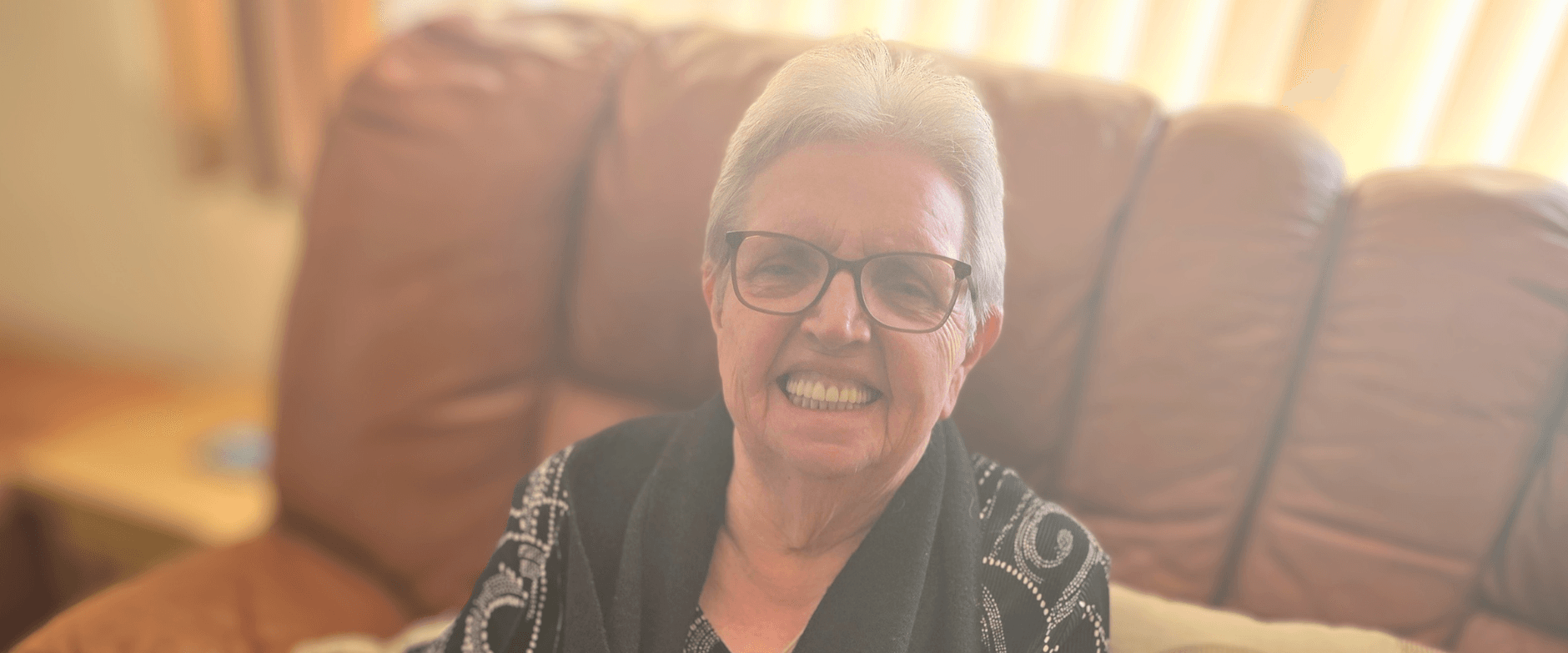
For Joan, home is everything.
She lives alone in her bungalow in Sheffield, but she is rarely without company. Her son and daughter visit regularly, and other family members call in daily to check she is alright. Family, she says plainly, are the most important thing in her life.
When Joan was admitted to hospital following a fall in the summer of 2025, returning home safely, and staying there, was what mattered most. She was living with Multiple Sclerosis, oedema in both legs, and was assessed as being at high risk of further falls on discharge.
She began receiving support from Be Caring in September 2025. From her very first conversation with the team, Joan was clear about what she wanted:
“To be able to be as independent as possible and be comfortable in my home.”
Support That Starts With Listening
On discharge, Joan needed a significant level of support to manage safely at home. Her initial care package was four daily double-handed calls. Specialist equipment was in place – a profiling bed, pressure-relieving equipment, mobility aids and a wet room – to manage risk from the outset.
But from the beginning, Joan’s Care Workers understood that their role wasn’t simply to complete tasks. It was to support Joan to do as much as possible for herself.
Be Caring’s structured outcomes framework gave Joan an opportunity to say how she felt her independence was progressing. At her first review in October 2025, she rated herself 4 out of 5 against the statement “I am as independent as I can be” – and was specific about what she wanted. She didn’t want Care Workers doing things for her and said “I am still trying to become more independent.”
Working With Joan, Not For Her
The shift in approach was practical and consistent. Care Workers were guided to work alongside Joan rather than ahead of her. Small adaptations made a real difference – milk was decanted into a lighter jug so Joan could pour it herself. Walks to the kitchen using her Zimmer frame were encouraged and supported, building both confidence and mobility steadily over time.
A care note from October captures one of those early moments:
“Supported her with her Zimmer frame to stand, we both went to the kitchen to heat her meal prepared by granddaughter.”
It is a small detail, but it says a great deal. Joan wasn’t being cared for from the armchair. She was moving, participating, staying part of her own daily life.
Through November, care notes showed Joan walking around her home with increasing confidence. Her Care Workers reinforced safe practice consistently, celebrating progress and encouraging Joan to take the lead wherever she safely could.
Then, in December,
“I asked her what she would like to eat for breakfast. She said she will do it by herself. She stood up to the kitchen; she prepared herself cornflakes and a cup of coffee. I assisted her to bring it to the lounge.”
A Meaningful Outcome
By 2026, Joan was routinely preparing her own breakfast, managing short walks within her home, and needing significantly less hands-on support. Her Care Workers reported improved mobility and growing confidence, with no safety concerns raised.
Most significantly, Joan has had no recorded falls since returning home from hospital.
As a direct result of her progress, Joan’s care package was formally reviewed and reduced. She moved from four daily double-handed calls to two single-handed calls – a morning visit and a teatime visit. Less dependence on formal care, more independence, and exactly what she had asked for.
What Joan’s Story Shows
Joan’s journey reflects what Be Caring’s model is designed to make possible. Because our Care Workers are paid on block shifts – for their full time, not by the minute – they are never rushing through a visit to reach the next one. They have the time to walk to the kitchen alongside someone, to encourage rather than simply assist, to notice the small moments of progress that add up to something significant.
Our outcomes framework ensures that what matters to Joan stays at the centre of her care; tracked, reviewed, and reflected back to her as evidence of her own progress.
Joan came home from hospital in September 2025 wanting to be as independent as possible, in the home she loves. Five months later, she is making her own breakfast, living with less formal care, and has not fallen once.
That is what person-centred, outcomes-focused homecare looks like in practice.